

Japan rebuilt from ruins into a world power. So why is Africa still denied the same chance?
Japan rebuilt from ruins into a world power. So why is Africa still denied the same chance?
by Greg Fuller, Founder of Unlocking Our Voices
I went to Japan looking for Afro-Japanese stories. I left with a deeper question about Africa’s future.
When I booked my flight to Japan, I wasn’t chasing cherry blossoms or anime dreamscapes. I wanted to see, with my own eyes, how a country once devastated by war had rebuilt itself into a powerhouse of culture and technology. And as I walked through its streets, I couldn’t help but think of Africa.
The very word “Oriental” has long been wrapped in colonial fantasy: exotic, mysterious, sensual. For centuries, Europe painted Asia as backward and strange, ripe for exploitation. But what I found in Japan and China in July 2025 shattered those myths. These weren’t “backyard nations.” They were conservative, industrialized, and economically vibrant.
That realization forced me to ask: If the so-called Orient could achieve this transformation, why can’t Africa?
Rain on one continent, revelations on another
It was Friday, July 18. I had just wrapped up an interview in Mexico City with the brilliant Afro-Mexicana artist Kristina Gilo. Rain tapped against the windows as I packed my bags for a different kind of adventure, this time across the Pacific.
This wasn’t a trip for tourist snapshots or temple-hopping. My flight out of Mexico City that night would carry me 13 hours away, to Tokyo, in search of something far less documented: Afro-Japanese identity.
When I landed at Narita International Airport on Sunday morning, July 20, a cheerful Mario Brothers mascot beamed “Welcome to Japan.” A little thrill ran through me. I had made it to the land of the samurai. More than that, I was about to walk in the footsteps of Yasuke—the African who became a samurai retainer to Oda Nobunaga in 16th-century Japan. Believed to have come from East Africa, perhaps Mozambique, Yasuke remains one of the most powerful cultural symbols of African presence in Japan.
Sweat, spotless trains, and a nostalgic jazz riff
If Mexico had sent me off with rain, Japan greeted me with humidity. Ninety-one degrees and climbing, sweat already trickling down my face. Luckily, Japan’s railway system—air-conditioned, spotless, and futuristic—made the transition bearable.
On the way to Machida, it was impossible not to compare. Japan’s infrastructure outperformed anything I’d seen in the United States: trains that ran like clockwork, streets that stayed clean, homes built smart and efficient, cars brimming with technology. It left me wondering, was I coming from a so-called “developed” country, or a Third World nation still pretending to lead?
Machida brought me my first surprise of the trip. I ducked into a small café called The Coffee, and just as I walked in, Oscar Peterson’s C Jam Blues floated from the speakers. To hear Black American jazz, born in the segregated Jim Crow South of the 1940s, welcoming me in Japan was surreal. It was like home following me halfway around the world.
The waitress, smiling politely, noticed my struggle with the Japanese menu and used her phone to translate. Technology bridged the language barrier, but what really struck me was her grace. Even in that small exchange, I glimpsed Japan’s cultural identity in the effortless respect she showed me.
Walking through cities once marked for fire
Like with most of my travels, I arrived with a list of contacts and places to see. At the top of that list was Sena Voncujovi, an Afro-Japanese man whose story had partly inspired my trip. His journey is so significant that it will become the focus of part two in this blog series. I also wanted to experience Tokyo and Kyoto; two cities that carried heavy World War II histories.
Kyoto, once marked as a potential atomic bomb target, was spared. Tokyo, by contrast, bore the scars of relentless bombing campaigns. And of course, it was Hiroshima and Nagasaki that ultimately witnessed the devastation of nuclear fire.
Walking those same streets in 2025, I didn’t see rubble. I saw a country that had rebuilt itself into the future, without erasing its past. Japan had been defeated, occupied by the United States from 1945 to 1952, its emperor stripped of divinity, its constitution rewritten with American ink. Black American soldiers patrolled its soil. Yet even through humiliation, Japan absorbed what it needed and kept moving.
By the second half of the 20th century, American occupation had left traces—jazz, dance, style—but it hadn’t uprooted Japanese culture. Instead, the nation emerged stronger, modernized, and remarkably intact.
What Japan rebuilt, Africa was denied
Japan’s resilience left me reflecting on how differently Africa’s story has unfolded. Our continent has endured centuries of extraction, first through the Trans-Saharan slave trade and then the European Atlantic slave trade.
From the 7th century until the early 20th, Arab traders imposed language, culture, and religion. Men were mutilated into eunuchs, women stolen as concubines. Later, European colonizers arrived with their triad of God, Glory, and Gold. Africa’s bodies, lands, and resources fueled Europe’s industrial revolution.
Then came the Berlin Conference of 1884–85, where European powers carved the continent like a pie. Native tongues were suppressed in favor of English, French, German, Arabic, Spanish. Tribalism was weaponized. Western religions and values were imposed. And after “independence” in the mid-20th century, Africa was left with pseudo-states run by Western-educated elites—Black faces who often thought and governed like their colonizers.
Today, the legacy shows. Africa’s wealth is still extracted by multinational corporations. World Bank and IMF loans keep nations in dependency cycles. NGOs operate where governments should, while African talent continues to flee abroad. Unlike Japan, which rebuilt on its own terms, Africa has been repeatedly denied the chance to chart a sovereign course.
Dinner served by a robot, tradition still on the table
Thinking about Africa’s centuries of exploitation left me restless. So much had been stripped away from us in the name of “progress.”
In Japan, though, I kept noticing something different: a country that had modernized without losing its soul. I felt it most clearly over dinner one night in Machida, at Syabu-Yo, a shabu shabu restaurant where thin slices of meat and vegetables simmer in a broth at the table. My order wasn’t taken by a human but by a robot waiter. Japan, again, felt like the future.
And still, tradition held steady. The food itself, the ritual of cooking at the table, the quiet respect woven into the experience—it all reminded me that progress hadn’t erased heritage. Japan had leapt into technological leadership while carrying forward its spiritual outlook, ancestral reverence, and sense of place.
That contrast burned. Africa, too often, has been urged to shed its traditions for a version of “modernity” defined by outsiders. What if we chose another way; building forward without erasing who we are?
Torii gates, pure water—and the diaspora in plain sight
From restaurants to rituals, Japan kept reminding me that heritage and modernity weren’t opposites here. I felt it most vividly as I wandered Kyoto’s historic districts and stood beneath Tokyo’s great shrine.
In Kyoto’s Higashiyama district, I found myself surrounded by sloping wooden rooftops, narrow streets, and elegant temples. Kiyomizu-dera, with its sweeping stage and the pure waters of the Otowa Waterfall, stood as one of the most breathtaking. The temple seemed to hang in midair, balancing centuries of history with a city that had long since modernized around it.
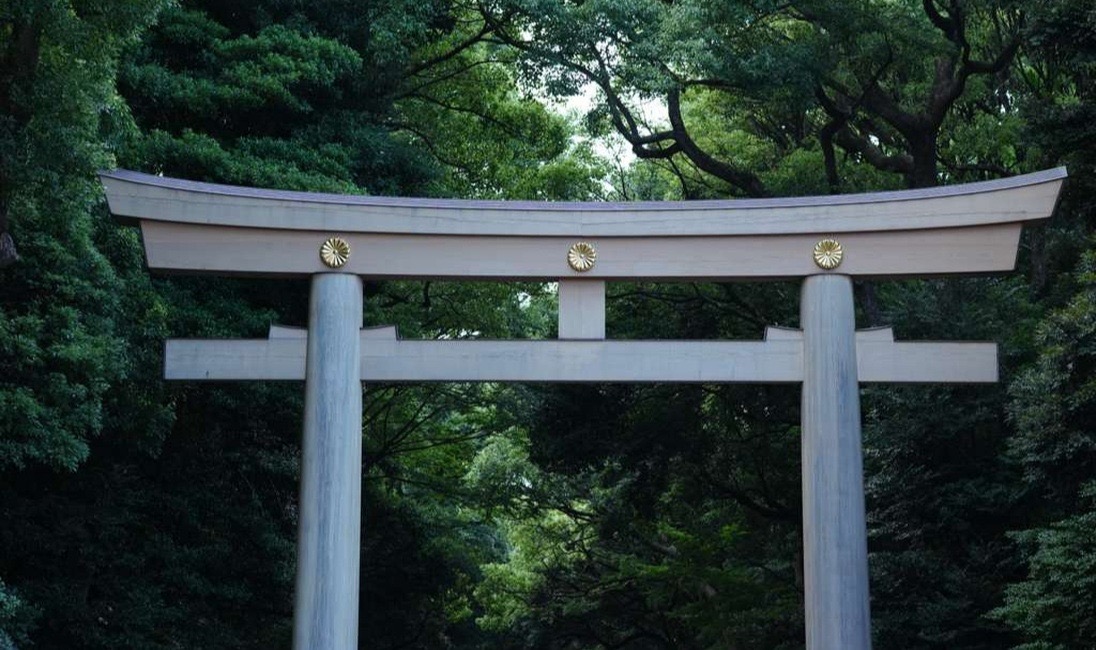
But it was Tokyo’s Meiji Shrine that captured my imagination most. Dedicated to Emperor Meiji and Empress Shoken, it symbolized Japan’s leap into modernity while holding tight to reverence for its past. Standing beneath its towering torii gates, I could feel the weight of that balance—forward momentum rooted in deep cultural soil.
Among the crowds, I also noticed faces of the diaspora—Black travelers making their own way through Japan’s maze of culture and history. Irene and her husband from Jamaica. Alex from the UK, exploring with his family. Jacob from California, tattoos bold against his skin. To me, they were living proof: we are everywhere, carrying the richness of Africa even when far from home.
And still, my journey wasn’t complete. The person I most wanted to meet awaited: Sena Voncujovi. An Afro-Japanese man on a spiritual quest, Sena embodies the intersection I had come to Japan searching for.
What Africa can learn from Japan
Looking at Japan—and to some extent China—the “why not us?” question pressed harder than ever. Japan endured devastation, occupation, even nuclear fire, and still rebuilt itself into a world power.
Africa, by contrast, has been fractured by centuries of slavery, colonization, and neo-colonial control. But that doesn’t mean we can’t reclaim our path. If Japan could adapt Western tools for its own advancement while fiercely guarding its cultural identity, Africa can too.
That’s the challenge and the hope: to use global systems—technology, economics, strategy—without losing ourselves. To rebuild not as imitators of the West, but as Africans rooted in our languages, our histories, our spiritualities.
Reclaiming our stories before they disappear
This blog is only part one of a larger journey. My time in Japan raised questions about resilience and Africa’s future, but it also led me to one of the most important voices of the Afro-Japanese experience: Sena Voncujovi. His story deserves its own space, and it’s where the next chapter begins, before extending the journey into China as well.
Through our podcast, Unlocking Our Voices, we’re reclaiming space for the African diaspora. We’re telling the stories that deserve to be heard. Amplifying the voices silenced for too long.
If any of this resonates with you, I invite you to join us. Tune into the podcast. Follow along on Instagram or subscribe to Unlocking Our Voices for behind-the-scenes clips and powerful visuals. Add your voice to the conversation.
Because there’s so much more to discover—and we’d love to have you with us.
Why the world needs to listen to Unlocking Our Voices
Lalibela Nile